

The world is entering an age of strategic fragmentation
Wars, trade tensions, technological competition and the rise of new power centres are breaking down the assumptions that shaped the international system for decades.
FOSTER! NEWS | GEOPOLITICS
15 SEPTEMBER 2026
THE OLD MAP OF POWER IS CHANGING
The international system is entering a period in which alliances are becoming less predictable, economic relationships are increasingly strategic and major powers are competing across several fronts simultaneously.
The war involving the United States and Iran, Russia's war against Ukraine, growing tensions between Washington and Beijing, instability in global energy markets and the expansion of BRICS are all part of the same broader transformation.
The world is not simply becoming more multipolar.
It is becoming more fragmented.
Countries are increasingly trying to protect their interests by diversifying alliances, supply chains, technologies and sources of energy.
The result is an international system in which cooperation and confrontation can exist at the same time.
BRICS WANTS A BIGGER ROLE
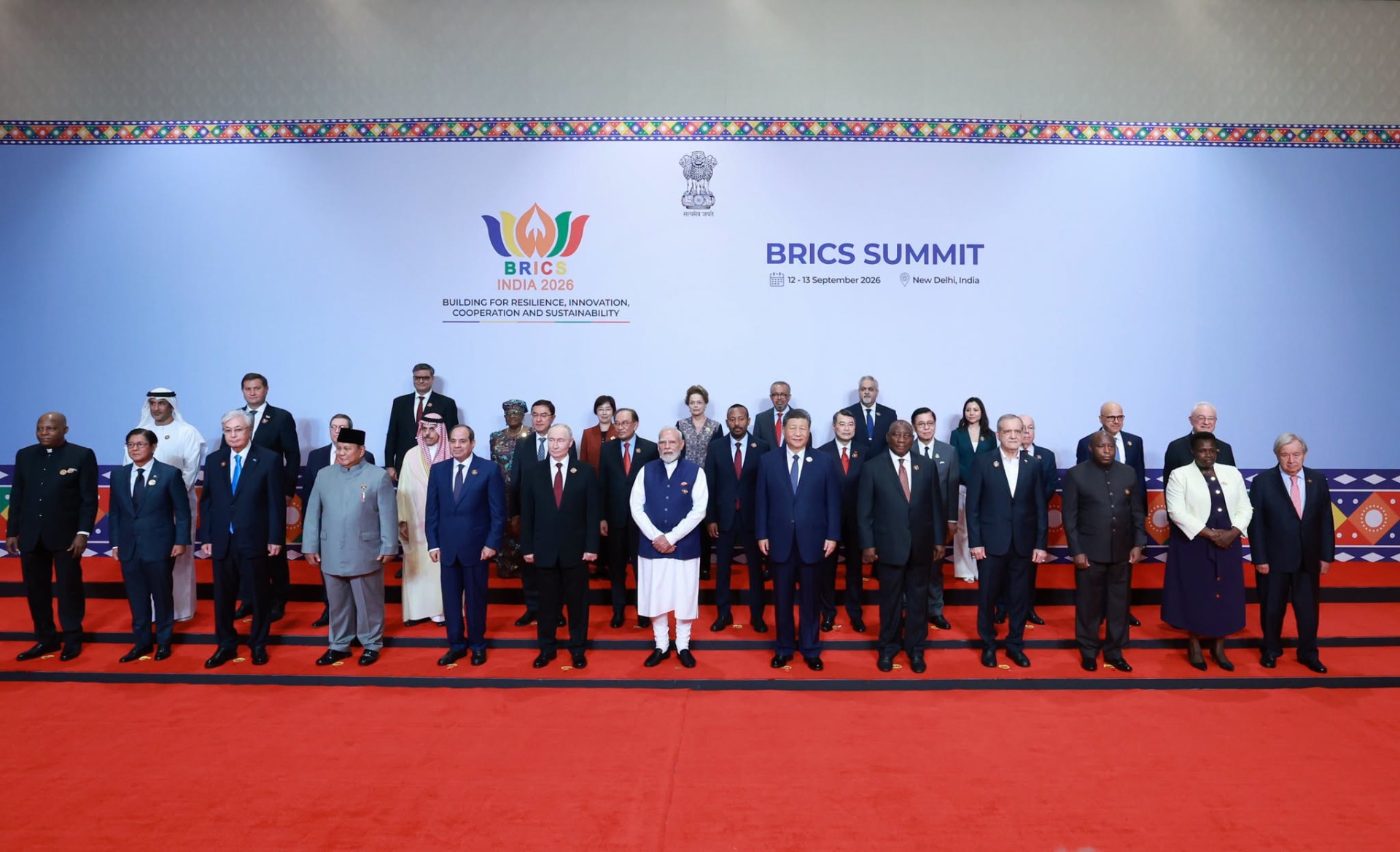
The 18th BRICS summit in New Delhi has provided one of the clearest demonstrations of this transformation.
The expanded grouping now includes Brazil, Russia, India, China, South Africa, Egypt, Ethiopia, Indonesia, Iran and the United Arab Emirates, alongside its wider partner framework.
At the summit, members adopted a joint declaration calling for restraint in the Middle East, opposing unilateral sanctions and tariff barriers, and supporting greater cooperation in areas including trade, finance, artificial intelligence, energy and climate policy.
The significance is not that BRICS has suddenly become a unified alternative to the West.
It has not.
Its members have profound differences.
India and China remain strategic competitors.
Iran and the UAE have conflicting interests.
Russia's war in Ukraine divides the international community.
And countries inside BRICS have different economic and political priorities.
But the organisation is increasingly becoming a platform through which emerging powers can demand greater influence over the rules of the international system.
THE GLOBAL SOUTH WANTS TO MOVE FROM RULE-TAKER TO RULE-MAKER
Indian Prime Minister Narendra Modi used the BRICS summit to argue that geopolitical tensions, supply-chain disruptions, climate pressures and the weaponisation of technology and critical minerals threaten global stability.
The summit also promoted greater use of local currencies, cross-border payment systems and cooperation in food security, energy and artificial intelligence.
This reflects a broader ambition.
Countries across the Global South increasingly want greater control over the mechanisms that determine international trade, finance and technology.
The question is no longer simply whether emerging powers will participate in the existing order.
It is whether they will help redesign it.
BRICS IS POWERFUL — BUT NOT UNITED
The expansion of BRICS gives the organisation considerable economic and demographic weight.
But size does not automatically create strategic cohesion.
The members disagree over foreign policy, security, economic models and the future relationship with the United States and Europe.
Some see BRICS primarily as a mechanism for economic cooperation.
Others view it as a way to resist Western pressure.
Still others, particularly India, appear to favour a flexible system in which BRICS can coexist with relationships with Washington and European capitals.
That ambiguity may actually be one of the group's greatest strengths.
BRICS does not necessarily need to become an alliance.
It can become something different:
a permanent negotiating platform for a more fragmented world.
INDIA IS BECOMING A MODEL FOR STRATEGIC AUTONOMY
India's position illustrates the new geopolitical environment.
New Delhi is simultaneously strengthening relationships with the United States, maintaining important economic ties with Russia, competing with China and leading the BRICS process.
This is not traditional bloc politics.
It is strategic autonomy.
Chatham House has described India's approach as an increasingly relevant model as the Ukraine and Iran wars, US-China rivalry and the Trump administration force other countries to reconsider rigid alignments.
India's strategy is simple in principle:
Do not depend completely on one power when several powers need you.
Other middle and emerging powers are increasingly examining the same approach.
CHINA IS BUILDING A DIFFERENT KIND OF POWER
China's influence is not based exclusively on military strength.
Its power extends across trade, manufacturing, infrastructure, technology, finance and supply chains.
At the BRICS summit, Chinese President Xi Jinping promoted deeper cooperation among the expanded grouping, including initiatives involving artificial intelligence and economic development.
Beijing is also preparing to assume the BRICS chairmanship for the next cycle.
That gives China an opportunity to shape the group's agenda at a moment when the international system is already undergoing major structural changes.
But Beijing faces a strategic challenge.
The larger BRICS becomes, the harder it is to turn Chinese influence into collective policy.
WASHINGTON STILL HAS ENORMOUS POWER
The fragmentation of the international system should not be confused with the disappearance of American power.
The United States remains a dominant military, technological and financial actor.
The dollar remains central to international finance.
American companies remain at the forefront of artificial intelligence and advanced technology.
And Washington maintains alliances and partnerships across Europe, Asia and the Middle East.
But the way American power is being used is changing.
Trade policy has become more confrontational.
Security relationships are being reassessed.
And countries that once automatically aligned with Washington are increasingly calculating their own interests.
The result is not an American retreat from the world.
It is a world in which American power faces more negotiation than before.
THE TECHNOLOGICAL WAR IS BECOMING A GEOPOLITICAL WAR
One of the most important battlegrounds is no longer a geographical territory.
It is technology.
The United States and China are engaged in an increasingly intense competition over artificial intelligence, advanced chips, engineering talent and digital infrastructure.
Recent analysis has compared the rivalry to a new technological cold war, with both powers seeking to prevent the other from establishing decisive advantages in advanced AI.
The implications extend far beyond technology companies.
AI is becoming relevant to:
- military planning;
- intelligence;
- cyberwarfare;
- industrial production;
- finance;
- healthcare;
- communications;
- autonomous weapons;
- and economic competitiveness.
Control over advanced computing is therefore becoming part of national power.
CRITICAL MINERALS ARE THE NEW STRATEGIC TERRITORY
The geopolitical competition is also moving underground.
Lithium.
Cobalt.
Copper.
Nickel.
Rare earth elements.
Graphite.
These materials are essential to batteries, renewable energy systems, electric vehicles, electronics and advanced defence technologies.
Governments increasingly regard access to them as a national-security issue.
That changes the meaning of natural resources.
A mine is no longer simply an economic asset.
It can become a geopolitical asset.
Africa, Latin America, Australia and parts of Asia are consequently gaining strategic importance as major powers seek to secure supply chains.
ENERGY REMAINS A WEAPON
Despite the rapid development of renewable technologies, hydrocarbons continue to shape international politics.
The war involving Iran has demonstrated once again how quickly instability in the Middle East can affect global energy markets.
At the same time, Russia's war against Ukraine continues to have consequences for European energy security.
The result is a world in which countries are trying to diversify energy sources while simultaneously protecting existing supply routes.
The strategic calculation is increasingly:
WHO CONTROLS THE RESOURCE?
WHO CONTROLS THE ROUTE?
WHO CONTROLS THE TECHNOLOGY?
THE ARCTIC IS BECOMING ANOTHER FRONTIER
Geopolitical competition is also moving north.
As sea ice retreats, Russia, China and the United States are increasing their attention to the Arctic, where new maritime routes and access to natural resources are creating additional strategic incentives.
For Europe, the development is particularly important.
The Arctic is becoming connected to questions involving Russia, NATO, energy, critical minerals and maritime security.
Greenland has also acquired greater strategic relevance.
The world's major powers are therefore competing across a geography that was once largely considered peripheral.
EUROPE IS BEING FORCED TO THINK STRATEGICALLY
Europe's position is changing as well.
The war in Ukraine, instability in the Middle East and uncertainty over long-term transatlantic security guarantees are forcing European governments to reconsider their defence and strategic capabilities.
Chatham House describes Europe as being at a strategic inflection point, with governments increasing investment in defence, technology and economic security.
The question is becoming increasingly European:
Can Europe remain economically powerful without becoming strategically dependent?
That question extends from defence to energy, artificial intelligence, semiconductors and critical infrastructure.
THE WAR IN UKRAINE HAS BECOME A TEST OF GLOBAL POWER
Ukraine remains one of the most important indicators of the international system's transformation.
The conflict is no longer only about Ukrainian territory and Russian security claims.
It has become a confrontation involving military technology, sanctions, energy, drones, intelligence, industrial capacity and alliances.
Recent Ukrainian drone attacks against Russian energy infrastructure have contributed to fuel shortages inside Russia, while Moscow has welcomed President Trump's call for Kyiv to stop targeting diesel infrastructure.
The conflict demonstrates another feature of modern geopolitics:
economic infrastructure can become a battlefield.
TRADE IS NO LONGER SEPARATE FROM SECURITY
For much of the post-Cold War era, globalisation was based on the assumption that countries would become more interconnected.
Today, governments increasingly ask whether that interdependence creates vulnerabilities.
Semiconductors.
Energy.
Food.
Pharmaceuticals.
Rare earths.
Telecommunications.
Shipping.
Financial systems.
All are increasingly viewed through a national-security lens.
The global economy is therefore not disappearing.
It is being reorganised around resilience and strategic dependence.
THE AGE OF PERMANENT COMPETITION
The emerging international system does not resemble the Cold War exactly.
There are no two completely separate economic blocs.
China trades extensively with Western countries.
India cooperates with Washington while participating in BRICS.
European countries trade with China while strengthening security against Russia.
Gulf states cooperate with the United States while expanding relations with China and other powers.
The new system is therefore more complicated.
Countries can be partners in one area and competitors in another.
COOPERATION AND RIVALRY ARE HAPPENING AT THE SAME TIME.
WHAT COMES AFTER THE UNIPOLAR ERA?
The post-Cold War period produced a world in which American power was unusually dominant.
That period is ending.
But its successor has not yet been established.
A Chinese-led system has not emerged.
A unified BRICS order has not emerged.
Europe has not become an independent strategic pole.
And the United States has not lost its central position.
The world is therefore passing through an intermediate phase.
An international system between orders.
FOSTER! ANALYSES
The defining characteristic of today's geopolitical environment is not simply the rise of one rival power.
It is the multiplication of strategic centres.
The United States remains powerful.
China is expanding its influence.
India is asserting strategic autonomy.
Russia continues to challenge the European security system.
Europe is developing greater strategic capacity.
BRICS is giving emerging powers a larger diplomatic platform.
And countries across Africa, Latin America, the Middle East and Asia are increasingly unwilling to accept a world in which they are simply expected to follow someone else's rules.
The consequence is a system that is harder to predict and harder to control.
The next global order may not be dominated by one country.
It may be defined by competition between several centres of power — and by the countries capable of moving between them.
That is the real geopolitical transformation.
The world is not simply becoming multipolar.
It is learning how to operate without a single centre.
And the decisions being made now — over technology, energy, alliances, resources and trade — will determine what replaces the international order of the past.
The next world order is not waiting to be announced.
It is already being built.
FOSTER! NEWS
Clear facts. Real context.