

Europe enters a new age of strategic uncertainty
Security, artificial intelligence, energy and the Arctic are forcing Europe to rethink its place in a rapidly changing world.
FOSTER! NEWS | EUROPE
14 SEPTEMBER 2026
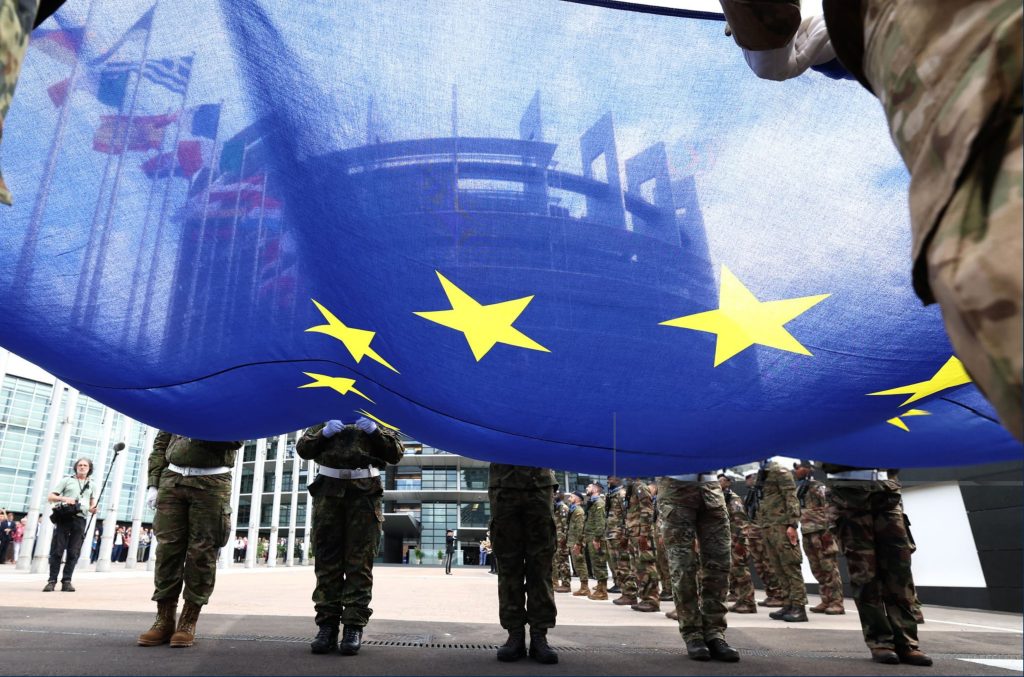
A CONTINENT REASSESSING ITS POSITION
Europe is entering a new phase of strategic uncertainty.
Across the continent, governments are confronting a reality that extends far beyond the war in Ukraine. Security, technology, energy, economic resilience and geopolitical influence are increasingly becoming part of the same question: how much control does Europe have over its own future?
The answer is becoming more complicated.
The geopolitical environment surrounding Europe is changing rapidly, while the continent faces growing pressure to strengthen its own capabilities and reduce critical dependencies.
From the Arctic to artificial intelligence, the boundaries of European security are expanding.
UKRAINE REMAINS AT THE HEART OF EUROPE'S SECURITY DEBATE
The war in Ukraine continues to shape Europe's strategic calculations.
The conflict has transformed defence planning across the continent and pushed European governments to reconsider military readiness, industrial capacity and the long-term security of the continent's eastern flank.
The European Union is also continuing to develop mechanisms to support Ukraine, including recent decisions concerning the eligibility of defence products for financial assistance under its Ukraine Support Loan framework for 2026 and 2027.
But Europe's security debate is no longer confined to Ukraine.
It is becoming a much broader discussion about Europe's ability to protect its interests in an increasingly contested international system.
A NEW EUROPEAN SECURITY DIMENSION
One of the clearest signs of this shift came from Finland.
On 14 September, Finland announced its participation in France's Forward Deterrence initiative, designed to strengthen European security and strategic cooperation.
France and Finland said the decision would strengthen their partnership and contribute to a stronger, safer and better-defended Europe. A Nuclear Steering Group is expected to begin implementing the cooperation in the coming months.
The development is significant because it illustrates how European countries are exploring additional forms of strategic cooperation alongside existing NATO structures.
It does not create a French nuclear umbrella for Finland. France retains control over its nuclear forces and their use.
But politically, the message is unmistakable:
Europe is thinking more seriously about its own strategic capacity.
THE ARCTIC BECOMES A NEW FRONTIER
Europe's strategic map is also expanding northwards.
European leaders gathered in Rovaniemi, Finland, on Monday for discussions about the future of the Arctic, a region becoming increasingly important because of climate change, new shipping possibilities, natural resources and growing competition between major powers.
Russia's military presence and China's expanding interests are adding another layer to the equation.
European officials are increasingly treating the Arctic not simply as an environmental or economic issue, but as a strategic one.
The implications are considerable.
As the Arctic becomes more accessible, control over infrastructure, maritime routes, resources and communications could become increasingly important to Europe's security.
EUROPE'S OTHER STRATEGIC VULNERABILITY: ARTIFICIAL INTELLIGENCE
Perhaps the most unexpected element of Europe's strategic debate is emerging from technology.
European Central Bank President Christine Lagarde warned on Monday that Europe faces an unprecedented risk of being cut off from artificial intelligence technology because of its heavy dependence on systems and infrastructure developed outside the continent, particularly in the United States.
Her warning goes beyond the technology sector.
AI is increasingly becoming part of healthcare, banking, transport, border management, public administration and other critical systems.
If access to that technology were disrupted, the consequences could extend across the European economy.
Lagarde argued that Europe needs greater domestic AI infrastructure, computing capacity and home-grown models in order to strengthen its digital sovereignty.
THE QUESTION OF TECHNOLOGICAL SOVEREIGNTY
This creates a dilemma for Europe.
The continent wants to accelerate AI adoption because the technology could significantly improve productivity and competitiveness.
At the same time, rapid adoption without sufficient domestic infrastructure could deepen Europe's dependence on foreign technology companies.
Europe therefore faces a strategic choice:
Adopt faster and risk greater dependency — or build its own capabilities and risk falling further behind.
The challenge is that technological sovereignty requires enormous investment in data centres, computing infrastructure, chips, research and talent.
It is no longer simply a question of innovation.
It is a question of power.
FROM ECONOMIC POWER TO STRATEGIC POWER
For decades, Europe's greatest strength was often measured through its economic weight, its single market and its ability to influence global trade and regulation.
But the international environment is changing.
Economic power increasingly depends on access to energy, technology, critical minerals, computing infrastructure, secure supply chains and military capabilities.
This means that the traditional boundaries between economics, technology and security are disappearing.
Europe's future competitiveness may depend on its ability to connect all three.
THE EUROPEAN QUESTION
Europe is therefore facing a much larger question than how to respond to any single crisis.
It must decide what kind of power it wants to become.
A continent that remains heavily dependent on external partners for defence, technology and strategic infrastructure?
Or a Europe capable of protecting its own interests while remaining deeply connected to the wider international system?
There is no simple answer.
But the decisions being made now — from Ukraine and the Arctic to nuclear deterrence and artificial intelligence — suggest that Europe has entered a new strategic era.
A CONTINENT IN TRANSFORMATION
Europe is not abandoning its traditional alliances.
It is reassessing them.
It is not closing itself off from the global economy.
It is questioning the vulnerabilities created by excessive dependence.
And it is not simply responding to a changing world.
It is beginning to recognise that its own capacity to shape that world will determine its future.
The European project was built around peace, integration and prosperity.
The next chapter may be defined by something else:
security, resilience, sovereignty and power.
Europe is changing. The question is whether it can change quickly enough.
FOSTER! NEWS
Clear facts. Real context.